The Paddle In The Park Contest is back for 2015!

Showing posts with label canoe trip. Show all posts

Saturday, June 15, 2013

The Stern Fathers


In today's modern world, a child still looks upon nature as a great mystery but with an immense disconnect. Good fathers put a child in the bow of their canoe and steer the investigation to ensure that immutable link to our natural world is established and understood. These are the "Stern Fathers".

___________________________________________________
"Must we always teach our children with books? Let them look at the stars and the mountains above. Let them look at the waters and the trees and flowers on Earth. Then they will begin to think, and to think is the beginning of a real education." ~ David Polis
___________________________________________________

Daddy-Daughter Canoe Session with Fat Paddler from Fat Paddler on Vimeo.
Awaking in the dark, daddy and his nearly 7 year old daughter head off for a canoe adventure in the nearby Ku-ring-gai National Park. An adventure of discovery, bonding, and of course a hot breakfast out in the bush!

Proudly brought to you by FatPaddler.com and BADGER® Paddles.
___________________________________________________

Your deepest roots are in nature.  No matter who you are, where you live, or what kind of life you lead, you remain irrevocably linked with the rest of creation." Charles Cook

___________________________________________________


So paddles up in gratitude to all the Fathers (like Poppa Badger!) who took their place at the stern and escorted us to those wild places, and who taught us that Nature is our teacher. A special thanks, also, to Sean Smith (a.k.a. The Fat Paddler) and his adorable daughter Gracie for sharing one of their very special and inspirational adventures, all the way from Australia, in honour of Father's Day. Plus an extra special thanks to our Mike for being Makobe's special friend, his protector, and his teacher - you are an exceptionally kind and loving Father to a boy with many exceptionalities. You, Mike, are truly a hero to me... and to your son.

Written by Fiona Westner-Ramsay

Happy Father's Day!

Happy Father's Day Poppa!


Wednesday, April 24, 2013

Pt 7 :: Making Room For Autism In Your Canoe - Backcountry or Car/End of the Portage


Dig this: April 2nd is World Autism Awareness Day (WAAD) and April is also known to many as Autism Awareness Month.  This multiple part story/part guide, written in honour of The Six Degree Project (Autism Awareness Celebrity Campaign) and WAAD, is the tale (with tips) of how we got to the end of the portage with our son. With hopes to help raise awareness about autism and the extra challenge it brings to lives of many families, including ours; we also hope this Making Room For Autism In Your Canoe "series" helps to inspire other families to get out there and live their dreams as best as they are able - because even though, with autism, our lives are different - they shouldn't be less. ~Fiona

Interior/Back Country or Car Camping?

Campgrounds are noisy, social places with lots of activity around. Hearing the noises of others outside the tent walls was truly unbearable for Makobe - terrified by the sounds that people were making so close to our tent (i.e. talking, walking on the gravel path, shutting car doors, off-key singing around a neighbour's campfire). We tried to camp in an Algonquin Hwy 60 Corridor campground this past summer and it became a complete nightmare for Makobe. We actually had to leave in the middle of the night to calm our son who was having a full on panic attack - then come back and pack out our belongings in the morning.

This trip was a true disaster once night fell.

Yet camping in the interior is not a problem for our Makobe. With only the sound of the crackling campfire - not neighbours - Makobe is able to settle into sleep in the tent without fear or anxiety. He is much more at home in a more natural camping environment that comes with portaging than he is with driving into a campground and setting up a tent. Another consideration is that there is less chance of autism interfering with a camping neighbour's experience when you are across the lake from them instead of just a few feet away.

By The End Of The Portage...


Nature has a way of returning peace to one's soul. I always knew there was some truth to this as I have felt it myself on the many canoe trips that I have taken since I was a child. But seeing Makobe, who struggles everyday with the noisy, overly busy modern day world, be able to just sit on the edge of a northern shore for a good while, and look out at the sky with a calmness that I don't see very often at home, makes me realize that the best thing we ever did was make room for autism in our canoe. Especially since we now know - it doesn't really take up that much room at all!


Written by Fiona Westner-Ramsay in support of The Six Degree Project Autism Awareness campaign.

To read all the parts to this story guide, click here: Making Room For Autism In Your Canoe

To read our report from Makobe's first wilderness trip into Algonquin, please click here: Making Room For Autism In Your Canoe - A Trip Report

**Stim(s) or Stimming are the terms most used to describe a self-stimulatory behaviour or activity that is performed repetitively and usually to the alienation of others.  Examples can be screaming, hand-flapping, finger play, rocking, spinning, lining up objects, verbal behaviour, etc.


Saturday, April 20, 2013

Pt 6 :: How To Make Room For Autism In Your Canoe - Paddling & Eating

Dig this: April 2nd is World Autism Awareness Day (WAAD) and April is also known to many as Autism Awareness Month.  This multiple part story/part guide, written in honour of The Six Degree Project (Autism Awareness Celebrity Campaign) and WAAD, is the tale (with tips) of how we got to the end of the portage with our son. With hopes to help raise awareness about autism and the extra challenge it brings to lives of many families, including ours; we also hope this Making Room For Autism In Your Canoe "series" helps to inspire other families to get out there and live their dreams as best as they are able - because even though, with autism, our lives are different - they shouldn't be less. ~Fiona

That tastes funny!

Another consideration for bringing children or people with eating sensitivities is how eating and preparing food in the outdoors can affect taste and texture. Especially when cooking over a fire. Makobe had many opportunities to eat meat and other types of food that had been cooked over a fire as we regularly do so as we visit Poppa Badger & Grammama’s land next door to us and camp. He will eat some of the items we cook over a fire but it is important we have a good coal base for cooking when preparing Makobe’s food. We cannot rush a cooking fire when he is around. If there is too much smoke flavor or black soot – he will not ingest it.


It is most important to consider all the aspects of a canoe trip when planning to take a sensory-sensitive person into the interior or backcountry - and practicing anything you think may become an issue at the campsite, before hand at home. Food intolerances can be tricky to deal with when on a canoe trip as space is tight (less choice) and the outdoor elements can alter texture and taste of some foods (food gets cold fast, rain can make everything wet and damp, etc.) But we noticed keeping Makobe physically active on trip (a natural by product of wilderness canoeing) kept him hungry and much more tolerant of what he put in his mouth.

Not just along for the ride:

Depending on the child, you may not wish to introduce the actual physical side of paddling until they are older or have shown they are interested. With Makobe, he liked to dip the canoe paddle in the water to create more of a resistance than to help paddle. He has some difficulty with it still (mainly because it can be hard work!) but has taken rather well to the simplicity of using a kayak paddle on a stand up paddle board. But the key to anything with Makobe (and autism) is motivation. It works much better if we have a destination in mind with a small tangible reward at the end of it for him. As for using a canoe paddle properly - still working on it!

Coming next: Backcountry or Car Camping?/Conclusion


Written by Fiona Westner-Ramsay in support of The Six Degree Project Autism Awareness campaign.

To read all the parts to this story guide, click here: Making Room For Autism In Your Canoe

To read our report from Makobe's first wilderness trip into Algonquin, please click here: Making Room For Autism In Your Canoe - A Trip Report

**Stim(s) or Stimming are the terms most used to describe a self-stimulatory behaviour or activity that is performed repetitively and usually to the alienation of others.  Examples can be screaming, hand-flapping, finger play, rocking, spinning, lining up objects, verbal behaviour, etc.

Tuesday, April 9, 2013

Pt 4: How To Make Room For Autism In Your Canoe - Practice Portaging & Gear

Dig this: April 2nd is World Autism Awareness Day (WAAD) and April is also known to many as Autism Awareness Month.  This multiple part story/part guide, written in honour of The Six Degree Project (Autism Awareness Celebrity Campaign) and WAAD, is the tale (with tips) of how we got to the end of the portage with our son. With hopes to help raise awareness about autism and the extra challenge it brings to lives of many families, including ours; we also hope this Making Room For Autism In Your Canoe "series" helps to inspire other families to get out there and live their dreams as best as they are able - because even though, with autism, our lives are different - they shouldn't be less. ~Fiona
Practicing for the portage at home.

Portaging at Home:

Just like practicing in the canoe, we also had to practice carrying packs around. Makobe is not always happy to carry things in his hands or have weight on his back, so this was a skill we needed to make sure he was able to partake in without much complaint before we expected him to pull it off on the trail after a long day of physical demands. Starting with lighter packs, Makobe would practice carrying gear on some of our walks and around our backyard trail. In the photo above, Makobe is carrying small pack filled with some gear for a day trip and our Wind Paddle for sailing in the canoe.

Appropriate Gear Makes For An Appropriate Experience:

It is very important to bring proper rain gear for everyone on a canoe trip, but it is especially wise to invest in a good breathable waterproof outerwear for any child or person with sensory sensitivities like those found with an autism diagnosis. Some people with autism are more sensitive to their environment and temperatures while others may not be able to communicate that they are feeling chilly. Sometimes a weather system can come in and catch you by surprise - things can get soaking wet and people can get cold really fast. Dressing in layers, including a fleece under a waterproof and breathable shell jacket/pants with waterproof boots can make for a very happy camper in wet conditions. The breathability factor is important as otherwise you really perspire, which can make you cold as well as your cloths remain damp from perspiration. 


Bug coats are also a really good investment. Deet is not at all good for you and for people with a sensitive olfactory system, the mere smell of it can make for a horrible experience. Not to mention the fact that many people with autism have an oral fixation and like to put many things, including their own hands and sleeves, in their mouths. It is also a difficult concept to teach a delayed child not to breath in the bug spray if they can help it!

For our first family back country canoe trip, Makobe had a bug coat, a youth shell jacket and pants from MEC and a pair of CROCS boots (he has a thing for CROCS, what can we say?!). Please note: Tarps are also a must for shelter or wind blocker in harsh conditions or heavy downpours, and bug nets can also help during the bug season if the child expresses major discomfort and frustration over the biting and buzzing insects. 

Coming next: Meltdowns & Communication in the Outdoors


Written by Fiona Westner-Ramsay in support of The Six Degree Project Autism Awareness campaign.

To read all the parts to this story guide, click here: Making Room For Autism In Your Canoe

To read our report from Makobe's first wilderness trip into Algonquin, please click here: Making Room For Autism In Your Canoe - A Trip Report

**Stim(s) or Stimming are the terms most used to describe a self-stimulatory behaviour or activity that is performed repetitively and usually to the alienation of others.  Examples can be screaming, hand-flapping, finger play, rocking, spinning, lining up objects, verbal behaviour, etc.


Sunday, April 7, 2013

Pt 3 :: Making Room For Autism In Your Canoe - Visual First-Aid


Dig this: April 2nd is World Autism Awareness Day (WAAD) and April is also known to many as Autism Awareness Month.  This multiple part story/part guide, written in honour of The Six Degree Project (Autism Awareness Celebrity Campaign) and WAAD, is the tale (with tips) of how we got to the end of the portage with our son. With hopes to help raise awareness about autism and the extra challenge it brings to lives of many families, including ours; we also hope this Making Room For Autism In Your Canoe "series" helps to inspire other families to get out there and live their dreams as best as they are able - because even though, with autism, our lives are different - they shouldn't be less. ~Fiona

Visual First-Aid

Many people with autism learn and are able to understand their world better when they are given visual examples and verbal warnings of what may come. Visual aids can be like first-aid when anxiety is an issue. Similar to the idea of using the canoe seat as a visual marker in the canoe, we also relied on other visual aids as well.


Our visual aids included information about where to go to the bathroom (i.e. the “Thrones” which are covered wooden boxes (with a opening for a toilet hole) placed over a dug hole that are used for going to the bathroom in Algonquin Park’s interior. Other parks, like Quetico, it is possible there will be no facilities available - where you are to dig a 6 inch hole in the ground instead). We had Makobe use the “Throne” when we were there as he has used an outhouse before. But as we know they aren’t pretty and usually present a very unpleasant odor, we also brought a back up toilet bucket for him to use in case he was unable to use the “Throne” due to sensory reasons and to prevent any health concerns or issues.


For our visual aids we used photos from our past trips (from before Makobe came into our lives), hand drawn pictures (including some of Makobe's own art) and even borrowed a few from the internet too. At first we used paper visuals but now rely more on the iPad* for a quick catalog of visual aids on the go.

Another visual and verbal strategy is the "FIRST-THEN" concept. It is a strategy that we, like many other families, use to help Makobe cope in certain situations.  At first used in a visual aid, we now use it verbally( or sometimes bring out visual aids for newer concepts).  For a verbal example, we used "FIRST paddle to the campsite THEN swim in the lake.” Note: when we returned from our trip we updated Makobe's Canoe Trip "picture story" with actual photos of Makobe and events that will be repeated on future trips as an updated visual aid and to help build his episodic memory.


*More about the iPad in the outdoors coming in the next post.

Coming next: Practice Portaging & Gear 


Written by Fiona Westner-Ramsay in support of The Six Degree Project Autism Awareness campaign.

To read all the parts to this story guide, click here: Making Room For Autism In Your Canoe

To read our report from Makobe's first wilderness trip into Algonquin, please click here: Making Room For Autism In Your Canoe - A Trip Report

**Stim(s) or Stimming are the terms most used to describe a self-stimulatory behaviour or activity that is performed repetitively and usually to the alienation of others.  Examples can be screaming, hand-flapping, finger play, rocking, spinning, lining up objects, verbal behaviour, etc.

Friday, April 5, 2013

Pt 2 :: Making Room For Autism In Your Canoe - Paddling At Home


Dig this: April 2nd is World Autism Awareness Day (WAAD) and April is also known to many as Autism Awareness Month.  This multiple part story/part guide, written in honour of The Six Degree Project (Autism Awareness Celebrity Campaign) and WAAD, is the tale (with tips) of how we got to the end of the portage with our son. With hopes to help raise awareness about autism and the extra challenge it brings to lives of many families, including ours; we also hope this Making Room For Autism In Your Canoe "series" helps to inspire other families to get out there and live their dreams as best as they are able - because even though, with autism, our lives are different - they shouldn't be less. ~Fiona

The Journey Begins, Paddling at Home:

The first time we put Makobe in a canoe - he was moving everywhere and not happy with the demand to sit in one area for any period of time. So we started with pretending to canoe in our living room using our paddles and our ottoman. Then in a real canoe with very small 10 to 15 minute paddling trips at first, working up to longer trips until we were able to spend a few hours in a canoe with a bit of motivation (usually a swimming spot for Makobe), a number of favourite fidget toys, and some edible reinforcement (gluten-free gummy bears or crackers). Using the principles of ABA (Applied Behaviour Analysis), we would praise Makobe for the behaviours we wanted to see. "I like how nice you are sitting!" and "Good job sitting quietly!" helped to let him know what we wanted from him by giving attention to those things. We allowed stims** that did not affect the balance of the canoe. And we always tried to end the paddling experience on a positive note so that his last memory of canoeing with us would be a reinforcing one.

Fidget toys can be a very helpful tool in a canoe!
Later, once he had learned how to sit balanced nicely,  it became naturally reinforcing for Makobe to be out in the canoe, especially when he could drag his hand in the water as we paddled along. We also provided Makobe with a camp seat (a soft folding chair, also known as a stadium chair, that can be strapped to a canoe seat to keep it in place) so that he was aware visually where he was supposed to sit and to help maintain balance in the canoe. Mike and I have many years experience paddling in canoes and we both lean our boats when soloing so we are aware of a canoe’s balance points, therefore we are both comfortable with Makobe leaning over to trail his hand in the water as we paddle along. Although in some conditions like rough weather, large waves, or with a heavily loaded canoe, this wouldn’t be possible - that is where the small fidget toys take over. (Fidget toys can be anything small that a child favours to help keep their hands and minds occupied - for example, some of Makobe's favourites are: Tangle Therapy, Spaghetti Balls, Stretchy Frogs, Koosh Balls, etc., see above photo)

We found the best place to sit Makobe (especially in the beginning) was within easy reach of the stern paddler. It is much easier to physically control a child just in front of you than if you had to reach around behind you in a canoe. (This is also an important consideration in a meltdown situation, but more on that in a bit.) Later, once Makobe began to understand the balance of the boat better and his concept of canoeing had matured a bit, we moved him more to the middle of the canoe to allow room for gear and more leg space.

When we all felt comfortable with the progress made, the next step was paddling with large amounts of gear in the canoe - as this affects the feel and balance of the canoe considerably. It also gets a bit more crowded once all the packs and drybags are filing up the space. Thus, it is important to make sure that the child is comfortable and has some room to move around and shift to get comfortable on a longer paddle. We found that Makobe sometimes preferred to be packed in a bit but usually would sit up on a small pack for part of the journey for a better view and position.

Coming next: Visual First Aid


Written by Fiona Westner-Ramsay in support of The Six Degree Project Autism Awareness campaign.

To read all the parts to this story guide, click here: Making Room For Autism In Your Canoe

To read our report from Makobe's first wilderness trip into Algonquin, please click here: Making Room For Autism In Your Canoe - A Trip Report

**Stim(s) or Stimming are the terms most used to describe a self-stimulatory behaviour or activity that is performed repetitively and usually to the alienation of others.  Examples can be screaming, hand-flapping, finger play, rocking, spinning, lining up objects, verbal behaviour, etc.

Tuesday, April 2, 2013

Pt 1 :: Making Room For Autism In Our Canoe - We Used To Canoe Too

Legendary environmentalist, author, artist and cartographer
Hap Wilson wearing the Six Degree Project scarf for
Autism Awareness and Acceptance - WAAD 2013
(April 2) in snowy Muskoka, Canada.
(Abbey supports autism too! Ruff ruff!)
photo credit: Andrea Turner-Wilson

Dig this: April 2nd is World Autism Awareness Day (WAAD) and April is also known to many as Autism Awareness Month.  This multiple part story/part guide, written in honour of The Six Degree Project (Autism Awareness Celebrity Campaign) and WAAD, is the tale (with tips) of how we got to the end of the portage with our son. With hopes to help raise awareness about autism and the extra challenge it brings to lives of many families, including ours; we also hope this Making Room For Autism In Your Canoe "series" helps to inspire other families to get out there and live their dreams as best as they are able - because even though, with autism, our lives are different - they shouldn't be less. Thanks to our family and friends who have shown their support and a special thank you to Hap Wilson for showing his support for autism awareness and acceptance. ~Fiona

Hey, we USED to canoe too!
When our son, Makobe, received his diagnosis of autism at the age of two, we really didn't realize just how much our lives were going to change. My husband and I had met and it didn't take us long to find that a mutual love and passion for paddling and the outdoors were not the only things we had in common. Soon, after an extended travelling trip to B.C., we were married. Two years later we had our beautiful son. Even still, our relationship and careers were built and shaped by the paddle sports industry. We lived for paddling. However we soon realized Makobe's autism, with his over-hyperactive behaviours and inability to self-regulate, had made it nearly impossible for us to continue our regular paddling and wilderness canoe trips as a family.

Indeed, we were not alone. Mike and I have met many families along our autism journey that had given up a beloved pursuit because it didn't fit in very easily with the demands and difficult behavioural issues that autism brought to the child and family. "Oh we used to canoe too!" was a statement I grew weary of hearing. I knew why, of course - it is difficult enough to get thru a normal autism day let alone try to take on the extra challenge of a wilderness canoe trip! Unable to plan for a paddling trip, we knew we were well on our way to saying something similar to our friends and family ourselves until we discovered the principles of ABA (Applied Behaviour Analysis) and decided we were going to be a family of paddlers - even if it took us years to get there.

And it did. Eight years, in fact. Eight years before our son was ready for his real first wilderness canoe trip. There were many tears and meltdowns along the way but each struggle and hand-drawn visual aid was worth every minute when we walked across that first portage - a huge transition for Makobe - with great success, a little giggle, and a big smile. The smile was his Dad's. The giggle was mine but the great success all belonged to Makobe.


So after years of practicing and planning, we had finally made it! Yet there was more to this journey than we realized. Yes, we had learned how to make room for autism in our canoe; but by doing so, we had also learned how to better make room for autism in our lives. With the help of visual aids, the proper teaching techniques, breaking the big skills down into individual skills before being taught as a whole, Dr. Vince Carbone's Verbal Behaviour (VB) protocols, plus lots of patience and creativity - we realized that our son could do anything he put his mind too with our support and encouragement. Not to mention the principles of ABA (and VB) can be applied anywhere - yes, even on a portage!


Start'em Young
So while much of the tactics we used and will be sharing are for families of children with autism or special needs, much of this approach could also be applied to paddling with any child, really. It is important to remember that how our parents spent time with us as children influenced our idea of comfort when we later became adults. The more positive time you spend outdoors, in nature, with your children (at any age) - the greater chance they will seek out the wilderness later in life and with their own children as their chosen pastime. Getting young children to feel comfortable and enjoy spending time in the the outdoors is important; and remembering our connection with Nature is paramount for our survival on this planet. Besides, getting your hands filthy with camp dirt and feeling your feet get wet in the warm summer waters of a fresh water lake - or the salty sea - is something that everyone should have the pleasure of experiencing in their lifetime. And when children see their parents enjoying an outdoor experience and simpler life-style, they do too. It is also important to remember whether the child has autism or not - there is always room in a canoe for fun!

Coming NEXT: The Journey Begins, Paddling at Home


Written by Fiona Westner-Ramsay in support of The Six Degree Project Autism Awareness campaign.

To read all the parts to this story guide, click here: Making Room For Autism In Your Canoe

To read our report from Makobe's first wilderness trip into Algonquin, please click here: Making Room For Autism In Your Canoe - A Trip Report

**Stim(s) or Stimming are the terms most used to describe a self-stimulatory behaviour or activity that is performed repetitively and usually to the alienation of others.  Examples can be screaming, hand-flapping, finger play, rocking, spinning, lining up objects, verbal behaviour, etc.

Monday, February 6, 2012

Save Wolf Lake - Save Yourself

Just north of Sudbury (Ontario, Canada) and unbeknownst to most, lies the world's largest remaining old-growth red pine forest. Both Temagami area canoe route and environmental treasure, it's a place that belongs to ALL of us - not just man. It is also a place of great beauty and unimaginable ecological importance. A place that is under threat of being opened up to industry, (i.e. mining and even possibly LOGGING!) by the current Ontario government. With the change of just two words, it's designation will go from 'forest reserve' to 'general use', thus basically putting this old growth forest and it's resources up for sale.

But YOU can help SAVE WOLF LAKE with only a few "clicks". Send a message to this government, and help to ensure the future of Wolf Lake's protections by signing the online petition, and then faxing the Premier of Ontario via Earthroots Action Fax online . Now is a time to stand up for our planet. Not everything can be for sale in this world. This is one of those things. Our planet needs your voice. Wolf Lake needs your voice. You need your voice. Your children need your voice. Your grandchildren and great grandchildren will thank you for speaking up when you had the chance. And mine will too.

Visit (and share) the website www.savewolflake.org/ for more information and to take action now!


Friday, January 6, 2012

When Bears Badger - An Algonquin Tale

Apparently, I was taken on my first canoe trip into Algonquin Park (Canoe Lake) when I was was quite young - only 18 months old. And it wouldn't be my last, although I did end up growing out of the papoose pretty quickly.

Throughout my youth I would spend summers with my parents (who were quite avid canoeists, as it turns out) outside in a tent. Living in Toronto, we spent quite a bit of time as a family in Algonquin, traveling various routes throughout the Lake Opeongo, Canoe Lake and North Tea/Fawcett Creek areas.

Actual "permit" from Fiona's
very first canoe trip.
Pocahontas And Me
Looking back now, I was very lucky to have parents who hauled me out of the city each summer to experience a more natural world. Especially seeing my friends took to referring to our part of the city as the DLS (Dirty Lakeshore).

But my father, Mike, and my mother, Mhairi (pronounced Mary - it's the Gaelic spelling) didn't want to do anything else on their vacation other than paddle. Spending time in the wilderness had a profound effect on me growing up. As a young girl, I quite literally wanted to be Pocahontas. But to me, the most memorable of my canoe trip experiences, (besides everything!) was our many encounters with the native wildlife. Those of you who have been a few steps, or paddle strokes away from an animal in its natural habitat, are probably best able to understand how sharing a peaceful moment with a wild creature can be a remarkably rewarding experience. Even spellbinding at times.

Our family was lucky enough to have connected with nature many times over the years. We have had the distinct pleasure (and luck) to view many a Black Bear, Moose, Deer, Fox, Rabbit, Raccoon, and many other forest creatures as well as the Loon, Wood Ducks, Turkey Vultures, Eagles, Ravens, Heron, Grouse, Mink, and more. My father, "Poppa Badger", once even saw the very elusive Wolf (I missed it being on the other side of the portage). Some of these creatures we happened upon unwittingly and to the surprise of all parties involved. Others we waited for hours to see, tucked away in our boats in the swamp of some back bay.


Most of these memories have blurred over the years. All but for one, that is. Perhaps I was just the right age for remembering. Or maybe it was because it was the scariest night of my life.  Either way, the experience left its mark in my memory.  Whenever I go there in my mind, I am that little seven year old girl again. And the whole day and night come flooding back to me.

"There's a man in the tree!"
It was the last two days of a week long canoe trip. My mother, my father... and me. We were just coming off of the Manitou to North Tea Lake Portage in Algonquin Park. Our last night night was a scheduled stop on North Tea before carrying on, the next day, to the take out a few short portages away. Being a long weekend in the summer, campsites were scarce. My parents left me on the beach of a site, just around the corner from the last portage, while they paddled a short distance to see if any other sites were available closer to the next portage on our route. I was given strict instructions to stay on the beach. No swimming allowed and warned they would see me from their canoe if I misbehaved. They were going to be twenty minutes - maybe thirty - tops.

I made myself comfortable on the beach and began to sculpt the sand into some sort of Algonquin themed creation. Losing myself in play, my parents were back before I was done with my sand fun. It was still quite early in the day so my parents let me choose pancakes for lunch. Pitching the tent and other camp duties were tended to as I learned from my father that there wasn't any other available sites. I also learned that he wasn't sure if we should stay on North Tea Lake or not as there was a "bear warning" issued to all paddlers at the put in when we first arrived. But seeing as we had already started to unpack and set up camp, and nobody wanted to give up their last night in the park, the decision was already made.
My mother and father have paddled together since they were in their teens.
Soon we were settled in by the fire-pit and my mom began to mix up the pancakes. Dad lit up the old Coleman stove as we talked and prepared our meal. He was the best at making the pancakes. He would make make animal shapes and letters. Such fun to eat! It was a peaceful family moment that was suddenly interrupted by my mother's rather loud and excited exclamation "There's a man in the tree!" My father and I both glanced over in shock - as it would be the creepiest thing ever if there was some strange man staring at us, from a up a tree, in the middle of Algonquin's interior - long weekend or not!

Poppa Badger - or is it Indiana Jones?
However, my dad - upon seeing "the man" before I was able to -  quickly declared "That's not a man. That's a bear!" Which was quickly followed by "Grab me those pots and pans!" The bear, having been discovered in a tree just yards away from us, took his time making his way down it's trunk with incredible ease. He was obviously in no rush. That's when things became a bit scary. Loud noises usually scare bears away. But not this one. I remember feeling the chills coming off my father as EVERY TIME he banged the pots, the bear would stop... and (very) slowly turn around to look at us... Right in the eye. He would then give us a good stare down before turning back around and making his way to a trail that was to lead him deep into the forest. This showdown took place multiple times and the encounter didn't sit too well with my mother and father.

"We ain't seen no bears!"
There was some talk of the bear while we ate our flapjacks, which lead to a review in bear safety and a short visit by my dad to the neighbouring campsite - who was full of fisherman. This put my dad's mind at rest somewhat as he later told us the looks of their messy campsite was enough to convince him that if there was going to be any bear trouble - it would be at their camp site. But they had not seen any bears. So we took that as good news.

Little more was said in front of my little ears but I remember the tension. I also remember the night time routine being a bit different that particular evening. One of the biggest changes was the sudden appearance of a can of Naptha fuel by our tent entrance with a stick and the request for an old t-shirt from my father. He wanted to be able to have fire in a hurry and used the old t-shirt to wrap around the end of the stick to be used as a torch. I thought it was scary... but exciting. The other big change was the decision that I was to sleep BETWEEN my parents in the tent that night. And that hadn't happened since I could even remember! They also tethered me to my mother with some rope as an added precaution. To be honest, I have to admire my parents in this situation. They didn't want me to be frightened but they were honest enough with me that I was able to respect the seriousness of the situation. We had a bear in the area. And he didn't look like he was very afraid of humans.

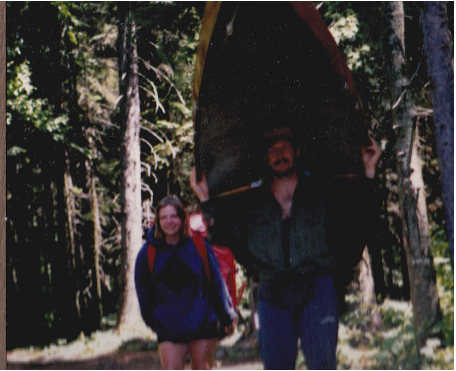
My young parents along an unspecified portage in Algonquin.
Bears In And Out Of The Tent
Taking all the precautions we could (hanging our food, leaving a super clean camp site, no food or toiletries in the tent, Macgyver-ing a ready-to-go torch of sorts, etc.) we finally retired to the tent for the night. The tension was intense. My dad, clearly on edge, planned to keep going outside over the course of the night to keep the Coleman lantern filled and lit. Our senses were heightened and every sound was amplified by our anticipation of a visit from the bear. It took a long while for us to all fall asleep as every few seconds an acorn loudly dropped from its branch and terrified the living daylights out of us. And they were dropping every where constantly! But eventually, our ears got used to the random beat of the acorns and we were lulled to sleep.

My next memory is of my father's frightened voice "Mhairi! Mhairi! Give me the flashlight!" My father, unbeknownst to us, had awoken to a most terrifying experience. At that moment he believed he could actually feel the bear's cold wet nose on his arm. It was pitch dark and he was very afraid. The flashlight beam broke the darkness of the tent while at the same time the tension broke with my father's huge sigh of relief. "It's just a tree frog!" he half laughed, half whispered. "It must have hitched a ride on me when I went outside to refill the lantern..."  Some of the nervous energy was then released by our giggles. Sleep eluded us all for a bit longer, but after some time we were able to drift off again to the sound of the acorn drums.

A young Fiona at Captain Dennison's grave - East Arm of Lake Opeongo
(There were many bear sightings over the years there too!)
The last time I awoke that night was like a nightmare. There were voices. My mom's side of the tent was caving in. I was wide awake with fear....we all were. It was the BEAR. And it was S-L-O-W-L-Y dragging it's body along the wall our tent. We could see the curve of it's body crushing and stretching the thin material to it's limits. It wasn't cool or exciting anymore. It was just really scary. No. Scratch that. It was terrifying.

It was not an expected move by this bear. There had only been reports of the bear being sighted close to campsites. Not tents. This was extremely bold behaviour for this bear. Any bear. And it did not bode well for it's future. Or perhaps even ours! I cannot help but think today that perhaps my parent's instincts and animal safety knowledge helped us get out of the situation without it needlessly escalating. We only had clean clothes on and/or stored in the tent (no shirts with food spills or pants that had smelly fish hands wiped on them) that night. Therefore no scents to attract or tempt an animal. Our food was hung up high and our camp and fire pit was clean. And while we usually took these precautions anyway, we did make sure to go the extra mile in our efforts in this situation due to the unusual encounter with the bear previously that day. Perhaps if we were messy campers or unknowingly had toothpaste or even a chocolate bar stashed in our tent with us, things could have ended differently. But then again, none of precautionary measures we took would have mattered if the bear had suddenly decided our family was worth the effort to eat.

Too Dark To See
As it was, the bear moved away from our tent. At which time my father had his flashlight in one hand and his hatchet in the other (with his torch ready for lighting) and was looking out the screen of our temporary, thin-walled shelter. He watched the bear, within the small beam of his flashlight, walk past our fire pit and then disappear into the blackness of the forest on the other side of our camp. With our hearts beating and our voices hushed, we all desperately hoped the bear was gone.

You have to look really close, but there is a bear in this picture.
(Although most would claim it's just a black dot!)
Not being able to get back to a restful sleep again, worried that the bear was still out there - no matter what "reason" told us - we were up early and started to take down our camp. We all talked excitedly about our very close encounter even though each one of us was exhausted from not having slept properly. As much as I was against telling the Rangers, I could not convince my dad otherwise. I was afraid they were going to shoot the bear and my little girl mind could not bear the thought of it! I think I even cried a little bit. But my dad was right. The bear's behaviour was dangerous and our experience needed to be disclosed to the Ministry. Especially as this bear was known to them. I believe they even had a nickname for the bear, although neither my father nor I can recall that name now. I never got the chance to find out what happened to that bear. I'd like to think that he was trapped/relocated and the bear lived happily ever after. Yes, that's the little girl in me talking.

To this day, when I close my eyes, I can still feel the fear in that tent. Sometimes... it comes back to me when there are a few cracks too many in the dark bush around me... with me in my very thin-walled nylon fabric shelter and lightweight sleeping bag. But then I always think about that "cold wet nose"... and the tree frog. And I smile and go to sleep, thankful for another day spent in a canoe and in the bush.  I don't make a torch up but I do carry "Bear Spray" now.... you know, just in case.

Written by Fiona Westner-Ramsay of Badger® Paddles